
Recently, Sony Corp announced a new product line of Bravia LCD TVs including the XR1 series, which has an RGB LED backlight unit. The company said that the XR1 series offers "the highest picture quality in the history of Bravia," and also has an extremely wide color gamut of 122% NTSC. It is scheduled for release on Oct 10, 2008, many of the details have yet to be released.

Based on the backlight unit of the latest series exhibited at the conference hall, we made a comparison between the XR1 series and LED backlight models released in the past.
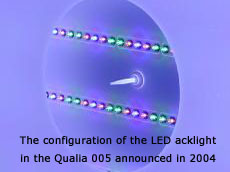
In 2004, Sony unveiled the Qualia 005, which was its first LCD TV incorporating an LED backlight unit. The Qualia 005 adopted a backlight technology dubbed "Triluminous," which used LED devices in RGB colors. It has a color gamut of 105% NTSC and uses a set of five LED devices arranged horizontally in the order of green, red, blue, red and green.

The second Triluminous model, the KDL-70X7000, was announced in August 2007. In this model, Sony drastically changed the alignment of LED devices, combining four LED devices, namely one red, one blue and two green, into one set. They are arranged in the shape of a diamond, with the two green devices vertically located, while the blue and the red were aligned horizontally. A lens-like component was placed on top of each device.

In the third version, Sony changed the alignment and the shape of the LED devices again. The layout, which consists of a set of one red, one blue and two green arranged in a square, is similar to that of the second version, but the alignment was changed. The green and blue LED devices are arranged on the upper row, and the red and green are set out on the lower one. The package size of each LED is smaller, and the distance between the packages looks narrower. The lens-like external part is not attached to the devices.
Thanks to the LED devices that are densely mounted in each set, the RGB colors can be effectively mixed to emit white light with less unevenness. Estimating from the small and densely mounted packages, the heat generated by each LED device may be lower than that of the existing models. The heat value of each LED device presumably decreased because its luminance efficiency was improved. Alternatively, the package size and the distance between the packages may be reduced by slashing the power input to each device. Sony has not disclosed the number of LED devices used in the backlight or the input power per device.