
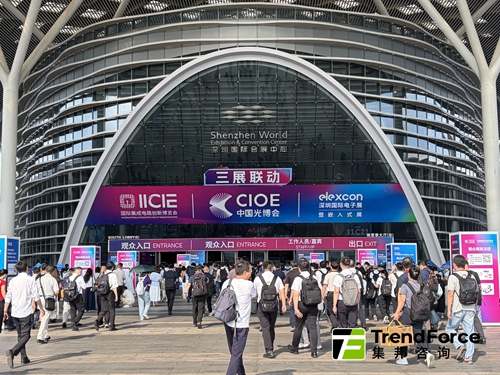
The 2026 China International Optoelectronic Exposition (CIOE) took place from September 9 to 11 at the Shenzhen World Exhibition and Convention Center. This year’s edition arrived at a pivotal moment as surging demand for AI computing intersects with accelerated advances in scaling optical interconnect technologies from 800G toward 1.6T and 3.2T connectivity. These trends have positioned CPO/NPO/XPO, silicon photonics (SiPh), OCS, and hollow-core fiber (HCF) as the defining themes of the exhibition.
Drawing on first-hand observations at the expo and preliminary background research, global market intelligence firm TrendForce noted that Accelink, Eoptolink, TFC, Luxshare Precision, Linktel, ShiJia Photons, Everbright, and Coherent prominently showcased their latest innovations in optical modules and components. Notably, several suppliers also unveiled cutting-edge solutions, such as 6.4T NPO light engines and 400G/lane modules.
Moreover, CIOE 2026 gathered international and domestic players from across the global optical communications value chain, including upstream suppliers of optical/electronic chips, semiconductor materials, and wafer foundries, as well as downstream manufacturers specializing in fiber-optic cables, system equipment, and testing and manufacturing equipment. This article provides an overview of exhibitor demonstrations from more than 25 participating suppliers, categorized by their specific roles within the industry value chain.
Semiconductor Material/ Substrate Suppliers
Enkris Semiconductor
Enkris Semiconductor showcased its GaN-on-Si Micro LED light source portfolio spanning from 8-inch to 12-inch wafer sizes. At a current density of 500A/cm², these products achieve a 1.6GHz bandwidth with power consumption below 1pJ/bit, providing a new Micro LED technology pathway for short-reach optical communications.
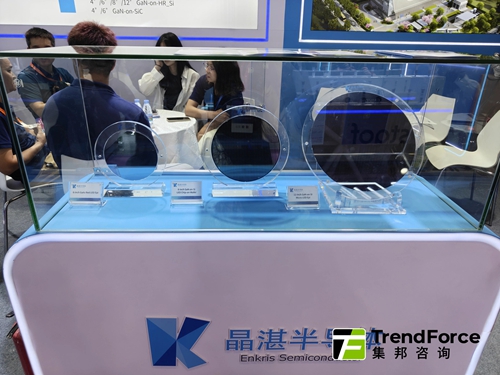
Enkris Semiconductor is a leading supplier of third-generation semiconductor GaN epi-wafers in China, with a deep expertise in GaN-on-Si epitaxial technology and a product portfolio targeting both power electronics and optoelectronics applications. As Micro LED technology gains traction from its potential in high-speed visible light communications, the company has been advancing its large-sized GaN-on-Si epitaxial technology into the emerging market of optical communication light sources.
San’an
Quanzhou San'an Semiconductor, a subsidiary of San’an Group, launched its next-generation optics platform. Spanning GaAs and InP material systems, this platform supports customized solutions for four major applications: optical communications, consumer and industrial applications, automotive optical communications, and automotive LiDAR systems.
In the optical communications sector, for access networks, San’an showcased its lasers, detector chips, and TO-CAN offerings designed for 2.5G PON, 10G PON, FTTX, and 50G PON applications. For telecommunication networking, the company has achieved volume shipments of its 10G/25G CWDM6 DFB laser diodes (LDs), 1270/1330nm DFB LDs, and 1310nm DFB LDs, along with matching photodiodes (PDs).
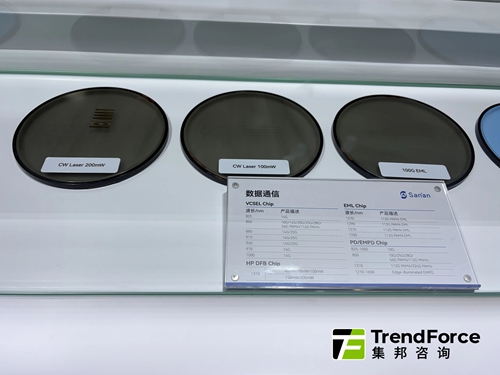
For data communications, San’an exhibited core lasers tailored for optical modules, including 70mW-200mW CW light sources, 100G VCSELs, 100G EMLs, and 100G/200G PDs.
In the consumer and industrial sectors, San’an demonstrated 638nm/650nm/905nm high-power FP lasers for displays, projectors, and ranging applications, as well as 1653nm DFB LDs and 1653nm PDs for gas detection, alongside 660-1060nm VCSELs for aesthetic medicine and optical sensing applications.

For automotive optical communications, San’an presented its wide-temperature 10G/25G 850nm/910nm/980nm VCSELs, along with 10G/25G 850nm/980nm PDs. For automotive LiDAR systems, the company exhibited its 1550nm NLW DFB chips, 905nm TJ VCSELs, and 1550nm NLW butterfly modules.
NanoLN
NanoLN showcased its full portfolio of single-crystal lithium niobate and lithium tantalate thin films, including 300-900nm lithium niobate thin films, 300-900nm lithium tantalate thin films, 6-inch single-crystal lithium tantalate thin films fabricated on silicon (300-900nm), 5-50μm single-crystal lithium tantalate/lithium niobate thin films, and 20-60μm ultra-thin lithium tantalate wafers, available in 3/4/6/8-inch wafer sizes.

As noted, NanoLN is the world’s first to commercialize 300-900nm single-crystal lithium niobate thin films, with more than 200 high-tech companies and scientific research institutions using its products. Starting this year, the company has mobilized its capital and capacity efforts: In April, NanoLN secured its seventh round of financing, led by a fund affiliated with China Jianyin Investment (JIC), and received a strategic direct investment from Nanjing Innovation Capital Group in partnership with the Bank of China through an asset investment company (AIC) fund. The company is now aggressively advancing toward an initial public offering (IPO), alongside plans to construct a new manufacturing facility. Upon reaching full capacity, the facility will yield an output of 500,000 thin films annually, with an eye on the emerging market for 1.6T and higher-speed optical modules, which is poised for accelerated growth starting in 2026.
Optical Chip/ Laser Diode Suppliers
Coherent
Coherent, a global leader in optics and CW LDs, showcased its full-stack photonic solutions to illustrate its comprehensive technological roadmap based on five major domains. In terms of intra-rack high-speed interconnects, Coherent boasts a diverse range of technological pathways, including silicon photonics, multi-mode VCSELs, and InP-based devices. Featured solutions on display included 6.4T pluggable CPO, 1.6T VCSEL NPO, and 12.8T XPO modules, alongside complementary components, including pluggable high-power CW external light source modules, SiPh micro-lens arrays, and polarization-maintaining fibers. These offerings are designed to meet the demands for high-density interconnects in AI scale-up clusters.

For long-haul optical connectivity, Coherent introduced the Multi-Rail technology platform, which leverages a universal optical resource pool to eliminate redundant hardware and decouple expansion in system capacity from linear increases in power consumption and footprint. Together with an optical line system (OLS) supporting both C-band and L-band spectrum, Coherent has leveraged its vertically integrated component manufacturing capabilities to create a foundational connectivity solution delivering tens of terabits per fiber, supporting scale-across networking across different regions.

Regarding high-speed optical modules, Coherent exhibited its full 400G/800G/1.6T transceiver series. The company has built on its vertical integration capabilities across optical chips, optical components, and optical modules to advance toward mature pluggable solutions and its cutting-edge CPO evolution.

In terms of DCI applications, Coherent presented its coherent optics for DCI and ultra-long-haul transmission solutions in tandem, with a focus on the bursty east-west traffic of AI workloads to enable high-speed, massive-volume connectivity across data centers. Meanwhile, the company showcased an optical circuit switch (OCS) solution based on digital liquid-crystal technology, providing low-latency, energy-efficient dynamic fabrics for large-scale AI scale-out clusters through reduced optical-electrical-optical (OEO) conversions.

Coherent also displayed industrial lasers, FBG laser fabrication solutions, and specialty optical fibers, targeting AI chip manufacturing, wavelength-locked high-power lasers, and other applications.

Hisilicon
HiSilicon exhibited its in-house optical chips and NPO solutions. Specifically, its VCSEL technology has achieved a breakthrough data rate of 200Gbps.

Meanwhile, a 3.2T VCSEL NPO prototype based on the OIF’s 3.2T co-packaging standard was demonstrated to support IEEE 802.3df 400G VR4/800G VR8 applications. Both its electrical and optical interfaces feature a 32-channel configuration, with each channel operating at 106.25Gbit/s with PAM4 modulation, alongside four MPO-16 connectors on the optical interface. This demonstration also achieved transmission distances of up to 50 meters on OM4 multi-mode fibers, or 30 meters on OM3 multi-mode fibers.
HiSilicon’s 3.2T VCSEL NPO solution features digital diagnostic monitoring, multimode VCSEL technology, and a non-hermetic COB packaging process, while achieving a total power consumption below 21W.

MTC

MTC displayed its full lineup of optical chips, including 2.5G/10G/25G DFB chips, 50G PON EML+SOA chips, 100G/112G PAM4 EMLs, and 70mW/100mW/200mW CW DFB chips, addressing full-scenario requirements from access networks to data centers. The company has also established an end-to-end integrated device manufacturing (IDM) platform that seamlessly integrates chip design, epitaxial growth, wafer fabrication, testing, and reliability validation.
MTC exhibited 1.25G-800G full-rate optical modules for a diverse range of applications, such as data centers, AI computing systems, 5G/6G networks, and access networks. In recent years, MTC has further intensified its investments in the optical communications sector, with its 400G and 800G optical modules now achieving small-batch shipment and transitioning into commercial mass production at full scale. Meanwhile, the company has accelerated the development of its 1.6T optical modules.
Additionally, MTC features high-static-performance CW DFB LDs on par with mainstream competing products, with samples now being delivered to its customers. Furthermore, MTC has partnered with Hunan Normal University to establish a joint Micro LED CPO laboratory, aiming to achieve pilot production by 2028.
Everbright
At Booth 13 in the Information and Communication segment of CIOE 2026, Everbright highlighted its four optical chip lineups: the DFB LD, VCSEL, EML, and PIN PD series, which are positioned for applications across data centers, 200G/400G/800G/1.6T Ethernet, and SiPh modulated light sources. Featured products included 200mW CW lasers, 200G EMLs, 100G VCSELs, and other latest iterations.

Meanwhile, Everbright exhibited optical devices, fiber-coupled modules, optical arrays, direct diode lasers, and semiconductor lasers, all designed to extend the company’s reach into LiDAR and sensing, scientific research, agricultural laser technologies, and laser-enhanced nuclear fusion applications.
Shijia Photons

At this year’s expo, Shijia Photons demonstrated a lineup of featured products, including 200mW/500mW single-mode CW LDs, 800G arrayed waveguide gratings (AWG), MT-FA connection components, and 36/40CH FAUs. For passive devices, the company offers a full series of optical PLC splitters, AWG chips and modules of various configurations, and advanced components and intelligent optical modules, including VOA, OSW, TOF, WDM, VMUX, OCM, and EDFA. To meet the demand for 100G/200G/400G/800G/1.6T optical modules, it also showcased its AWGs, MT-FA optical connection devices, and FAUs, accompanied by matching products such as optical fibers and connectors, addressing the requirements for diverse applications, such as data centers and telecommunications.
In terms of active devices, Shijia Photons has built on its comprehensive active wafer platform to deliver end-to-end manufacturing services, spanning semiconductor laser design, epitaxy, tape-out, testing, reliability verification, and packaging. Featured laser offerings include DFB LDs, EMLs, SOAs, RSOAs, SLDs, and MOPAs, achieving a combination of performance indicators, including high power output, narrow linewidth, low noise, and high SMSR. These products cover wavelengths from 1260nm-1700nm, catering to mainstream CWDM, LWDM, and DWDM applications.

Shijia Photons also offers foundry packaging services, including COC, TO, TOSA, BOX, Butterfly, and various customized packaging solutions. With an operating temperature range spanning from -40°C to 125°C, its products are widely used across access networks, transmission networks, SiPh optical communications, LiDAR, optical computing, and satellite communications, thereby meeting diverse industry standards, including commercial, industrial, automotive, and aerospace-grade specifications.
ZJeagles Comsemi
At CIOE 2026, ZJeagles Comsemi launched new products targeting two major applications: AI optical interconnects and physical AI. The InP-based AI optical interconnect series includes 300G and 200G PDs, as well as 100mW and 70mW CW DFB LDs. Complementary to its GaAs ecosystem, these launches fill the gaps in its product portfolio by offering longer wavelengths and higher bandwidths.

The GaAs-based AI optical interconnect series features 200G VCSELs tailored for 800G/1.6T optical modules, NPO VCSEL light source solutions, and new-generation 100G VCSELs (GSG design). Together, these VCSEL offerings demonstrate their advantages in short-distance data center interconnects.

In the physical AI domain, ZJeagles Comsemi exhibited high-density, automotive-grade VCSELs, encompassing standard 2DMA VCSELs, cost-effective 2DMA VCSEL solutions, standard line-scanning VCSELs, multi-junction high-efficiency VCSELs, and polarized VCSELs. Notably, 2D addressable VCSELs serve as ideal light sources for solid-state LiDAR systems, enabling partitioned illumination that significantly enhances overall reliability at the device level. The company is also actively establishing its presence in emerging markets, such as embodied AI and consumer robotics.
Light Engine/ Optoelectronic Integration Solution Suppliers
POET Technologies
POET Technologies highlighted its Teralight 1.6T light engine solutions, alongside external light source products.
Regarding light engines, POET showcased a 1.6T Tx (transmitter) light engine solution that integrates 200G/lane EMLs and achieves 8-channel configuration using only four 2×200G EMLs developed by Mitsubishi Electric, as well as a 1.6T Rx (receiver) light engine solution that incorporates 200G/lane TIAs. Both the Tx and Rx chips feature integrated multiplexers (MUX) and demultiplexers (DEMUX), eliminating the need for discrete MUX/ DEMUX optical components required in conventional solutions. This integration also effectively reduces RF signal loss, modular design complexity, and component counts in the Bill of Materials (BOM).

Regarding external light sources, this year’s live demonstrations featured POET’s Blazar and Starlight series. The Blazar series includes integrated hybrid lasers tailored for co-packaged optics (CPO) and chip-to-chip optical interconnects. With wafer-level chip-scale packaging (WLCSP), an output power exceeding 100mW per channel is achieved.
The Starlight series is designed as an eight-channel high-power light source engine that supports multiple wavelengths. Designed for ELSFP (external laser small form-factor pluggable) modules, this series is available with O-band and C-band configurations. Additionally, established products such as the 100G LR4 Tx/Rx light engines and the 800G Infinity series were also presented on-site.
Optical Device/ Component Suppliers
TFC
TFC presented its light engines, external laser source (ELS) solutions, and HCWDM filter blocks, strategically securing a stronghold in the CPO and SiPh components sector.

TFC, a leading supplier of precision optics in China, started its business in precision ceramic bushings and has since evolved into a platform-based solution provider featuring passive components, active packaging, and high-speed light engines. As CPO architectures advance toward commercialization, ELS and light engine packaging have emerged as the company’s most critical growth drivers. TFC has introduced its relevant precision optical components and one-stop solutions into the global supply chains of mainstream optical modules and equipment manufacturers.
T&S
T&S exhibited its FOFCs (fiber optic flex circuits), shuffle boxes, polarization-maintaining fibers, FAUs, MT ferrules, and multi-core fan-in/fan-out devices.

T&S is a publicly listed optics supplier based in Shenzhen, specializing in optical connectors and passive components. Featured products such as MT ferrules and fiber connectors have achieved industry-leading production scale and yield rates. To meet demands for high-density cabling in AI data centers, the company has recently focused on high-density MPO/MTP interconnects, FAUs, and flexible optical substrates, gaining momentum from an uptick in demands for 800G/1.6T optical modules and CPO solutions.

JPT
JPT highlighted its optical connectivity products designed for high-density interconnects within AI computing centers.

On the product front, JPT exhibited three major series. First, the high-density fiber-optic connector series encompasses MMC, SN-MT, MPO/MTP trunk cable assemblies, breakout patch cords, MT jumpers, and fiber arrays. With low loss, high return loss, high density, and a miniaturized footprint, these products are well-positioned for data centers, high-speed optical communication systems, telecommunication base stations, and optical modules.
Second, the fiber patch cord series covers various interface types, such as LC, SC, ST, FC, MU, MTRJ, and E2000, while supporting single-mode/multi-mode and simplex/duplex configurations. Third, the outdoor and hybrid optical cable series includes standard interfaces, such as PDLC, CPRI, NSN, and ODVA, while supporting IP67 protection and the integration of multi-core optical fibers with power lines in outdoor applications, including wireless base stations and FTTX networks.


JPT has made significant strides in its optical networking business this year. In 1H26, the company recorded a revenue of RMB 1.487 billion, representing a YoY growth of 68.86%, alongside a net profit attributable to shareholders of RMB 195 million, up 105.25% YoY. Notably, revenue from the fiber optic device business reached RMB 399 million, a remarkable increase of more than 23 times YoY, while the value of delivered MPO/MMC orders also surged by more than 20-fold YoY
In July, JPT announced its plan to acquire a 100% equity stake in NEOPTICS PTE. LTD. for SGD 1.12 million to strengthen its optical networking portfolio and expand its overseas sales network. In August, the company disclosed a private placement proposal to raise up to RMB 1.383 billion for construction projects, including production facilities for high-density optical interconnects.
Focuslight Technologies
Focuslight Technologies showcased its optical communication solutions centered on “Photonics Technology × Scalable Manufacturing.” Highlights of this year’s demonstration included its capabilities to deliver collaborative design and integrated photonic manufacturing spanning the entire value chain, including materials, components, modules, and equipment. To meet the demanding requirements of high-speed optical modules for AI data centers, OCS, NPO/CPO, and OIO applications, the company helps customers accelerate product development, improve manufacturing yields, and drive the deployment of next-generation optical communication technologies with high efficiency and scalability.
Demonstration examples included AlN substrates for SiPh NPO/CPO’s external light sources (ELS), addressing key requirements for thermal management in the SiPh and NPO/CPO era. Also on display were precision optics, such as integrated micro-lens arrays, fiber couplers, and collimators, which leverage the company’s cutting-edge V-groove technology to ensure high precision and reliability in fiber alignment.


O-Net
At CIOE 2026, O-Net showcased three major product lines designed for optical communications, data centers, and industrial applications. Products on display were categorized into five groups: micro-optics and optical connectors, QSFP-DD EDFAs, passive devices, coherent optical modules, and XPO/1.6T OSFP DR8 transceivers.
In its micro-optics and optical connectivity lineup, O-Net presented critical passive optical components and connectivity products for the optical module market, including isolators, MUX/DEMUX, and optical sub-devices. The company also provides pluggable connectivity products and solutions for CPO applications, alongside connectivity solutions such as MPO/MTP patch cords and shuffle boxes for data centers.

Notably, O-Net’s QSFP-DD EDFAs are designed for data center interconnects (DCI), featuring customizable optical performance and compliance with industry standards such as the QSFP-DD MSA specifications. This product also enables dual-channel amplification, AGC and APC modes, low-power operations, and an operating temperature range of -5°C to +70°C.

In its passive device lineup, O-Net recently introduced a folded, integrated micro-EDFA passive device, driving the miniaturization of EDFAs. Its optical switch series enables rapid, flexible multi-port switching and optical path protection, while its OCM and OTDR modules provide real-time monitoring for optical networks. Tunable filters are also used to filter out-of-band noise in high-speed coherent transmission. Furthermore, O-Net offers a comprehensive range of passive devices, including WDM, VOA, Tap-PD, in-line isolators, polarization-maintaining devices, and interleavers, providing customers with one-stop services spanning procurement and customization of multi-functional passive modules.
In its coherent optical module lineup, O-Net exhibited its 800G ZR, 400G ZR, and 400G CFP2 DCO modules designed for DCI applications and DWDM systems in metropolitan area networks (MAN). Notably, the 800G ZR module adopts a pluggable OSFP design in line with the OIF IA and OpenROADM standards. The 400G ZR module features QSFP-DD packaging, compliant with the OIF IA standard, and a power consumption below 18W, while the 400G CFP2 DCO module operates at under 24W.

Flyin Group
At this year’s CIOE, Flyin Group prominently showcased its high-density cabling solutions for AI supercomputers, alongside optical interconnect solutions for AI computing. The company demonstrated a comprehensive lineup of fiber array (FA) solutions, including LPO, NPO, and CPO architectures, while exhibiting high-speed optical modules, polarization-maintaining passive components, free-space isolators, and other core products. This portfolio offers full coverage across diverse applications, such as AI computing, data centers, 5G communications, and trunk cable transmission.
Among the five featured product categories at this event, the demand for interconnectivity in data centers and AI computing was highlighted: Flyin Group’s 400G/800G optical modules come with mainstream form factors, including QSFP-DD and OSFP, as well as 100G/200G PAM4 modulation capabilities. Its high-density MPO/MTP fiber-optic patch cords are available in a full range of specifications, including MPO-12, MPO-24, and MTP-16, and are paired with low-loss precision connectors to address the challenges of cabling congestion.

Flyin Group’s high-precision FAUs leverage precision V-groove manufacturing processes to achieve 100-micron-level precision in machining and positioning. Together with low insertion loss, high return loss, and low crosstalk, these FAUs serve as core coupling components for CPO and NPO systems. Its free-space isolators enable unidirectional beam transmission through the Faraday magneto-optical non-reciprocal effect, making them widely applicable to 400G/800G/1.6T optical modules, as well as CPO and NPO architectures.

YOEC
YOEC exhibited various optical devices, such as polarization-maintaining fibers, specialty fibers, high-power laser M2 beam quality analysis systems, and single-frequency narrow-linewidth laser modules. To meet the demands for large-scale AI computing, the company introduced high-density MPO cable assemblies, R5 bend-resistant PM fibers, and MT-FA passive fiber interconnect assemblies. These products span the entire supply chain from specialty fiber and optical cables to optical components, laying the groundwork for CPO, coherent communications, and next-generation high-speed interconnects.

Regarding fiber-optic sensing systems, YOEC showcased its mass production capabilities through the combination of an angular velocity inertial sensing platform and an underwater vibration sensing platform. Applications include inertial navigation systems (INS) for sea, land, air, and space; ocean exploration; and the low-altitude economy. The company has also developed independent and controllable technologies for photoelectric metrology and calibration.
Optical Module/ High-Speed Interconnect Suppliers
Source Photonics

Source Photonics showcased its full series of products for compute clusters, prominently featuring 800G, 1.6T, and 3.2T optical modules, as well as cutting-edge 6.4T NPO and 12.8T XPO modules, alongside 200G/100G PAM4 EMLs and high-power CW LDs. The booth also demonstrated a live traffic test of 1.6T optical modules in a switch-integrated setup.
During the event, Source Photonics revealed that its shipment volumes remain concentrated on 800G modules. The volume ramp-up of next-generation 1.6T modules will hinge on the future demand from the downstream market. As noted, the existing market for 1.6T switches in China remains constrained, with relatively few manufacturers capable of supplying 1.6T switches. Consequently, the delivery timelines of optical module manufacturers are predominantly guided by server and switch OEMs.

Accelink
Accelink showcased its 6.4T NPO modules, 320×320 OCS systems, and 400G/lane (targeting 3.2T) transceivers, along with L-band 800G coherent modules and the world’s first CFP2-packaged DAS module. Reportedly, Accelink’s world-first 3.2T SiPh single-mode NPO module has already completed validation with a leading CSP.

400G/lane technology marks a technological milestone on the path to 3.2T optical modules. As AI clusters continue to scale up, current mainstream 1.6T optical modules are predominantly based on a 200G/lane architecture. Compared to simply increasing the number of channels, 400G/lane technology can enhance the bandwidth density per fiber, reduce the number of parallel channels, lower system complexity, and optimize overall power consumption.
At the exhibition, Accelink showcased its 400G/lane technology in a live demonstration, highlighting its performance in high-speed interconnects within AI data centers. The demonstrated module incorporates high-speed DSPs built on an advanced process node, working in tandem with a 400G/lane light engine to build a complete solution.
Accelink also unveiled the world’s first miniaturized, pluggable CFP2-packaged distributed acoustic sensing (DAS) module, which was entirely developed in-house.
Accelink’s new 6.4T NPO light engine, designed for next-generation AI scenarios, incorporates an integrated transceiver SiPh chip, a linear direct-drive EIC, and a pluggable socket. By combining a 2.5D flip-chip packaging process with multi-channel high-precision coupling technology, this solution addresses three major system-level engineering challenges: high-density multi-channel signal integrity, high-power-density thermal management, and multi-channel high-precision optical alignment. Leveraging a 32×200G architecture centered on the optical engine (OE), this solution operates in alignment with ELSFP light sources and an FMU-Shuffle fiber management unit to deliver an end-to-end, full-stack NPO interconnect solution.
Furthermore, the company exhibited its 800G L-band OSFP ZR/ZR+ pluggable coherent module, which features in-house L-Band optical components. With its compact OSFP packaging, this module achieves an output power greater than 0 dBm, while maintaining stability in mass production.
Eoptolink
Eoptolink demonstrated its 1.6T/3.2T optical modules, 6.4T NPO modules, and 12.8T XPO modules, among others.

As a leading global manufacturer of high-speed optical modules, Eoptolink has achieved rapid growth in recent years, driven by the volume ramp-up of its 800G modules in overseas AI data center markets. The company is among the first in China to achieve mass shipments of 1.6T optical modules. Eoptolink has consistently invested heavily in low-power technologies, such as SiPh and LPO, while also establishing overseas production capacity in Thailand to support global delivery. Moreover, its 1.6T optical modules have played a pivotal role in the supply chain supporting the ongoing iteration of AI computing optical interconnects.
Luxshare Precision
Luxshare Precision exhibited its 12.8T XPO transceivers, 1.6T/800G OSFP 2×DR4 transceivers, a 3.2T NPO demonstration system, a 448G CPC interconnect demonstration system, and a standard ORW rack solution, demonstrating the full range of its interconnect capabilities spanning optoelectronic packaging and rack-level systems.

Luxshare Precision, as a leading precision manufacturer of consumer electronics, has recently extended its vertical integration capabilities into the AI computing infrastructure sector. This strategic expansion has enabled a comprehensive rack-level solution portfolio encompassing electrical connectivity, optical interconnects, power supply, and thermal management. At the exposition, the company’s focus on advanced optoelectronic packaging solutions, such as XPO and NPO, signals its strategic transition from being a “high-speed cable supplier” to an “AI rack-level interconnect platform provider.”
Linktel Technologies
Linktel Technologies exhibited its 1.6T LRO/LPO/FRO, 6.4T/7.2T NPO, and 12.8T XPO solutions, charting a comprehensive technology roadmap encompassing pluggable optics to near-packaged (NPO) and co-packaged optics (CPO).


Linktel Technologies, a high-speed optical module manufacturer based in the Optics Valley of China in Wuhan City, has long focused on the R&D of optical modules and CPO light engines. As low-power architectures, such as LPO and NPO, emerge as industry spotlights, the company has rapidly secured a footing by leveraging its deep expertise in high-speed light engines. At CIOE 2026, the comprehensive suite of LRO/LPO/FRO solutions and 6.4T+ NPO modules on display demonstrates that Linktel Technologies has positioned itself in the top tier of advanced optical interconnect architectures.
Hi-Optel

Hi-Optel demonstrated its optical and copper transceiver modules featuring data rates ranging from 10G to 800G. At CIOE 2026, the company shed light on its 800G, 400G, 200G, and 100G high-speed optical modules tailored for AI computing and high-speed interconnects used in data centers. The company also offers 40G, 25G, and 10G optical modules alongside copper modules, addressing the diverse requirements of datacom and telecom networks.

Hi-Optel, a state-controlled enterprise held by Fujian Qingshan Paper Industry, operates a comprehensive production line spanning from TO-packaged components to optical modules. Specializing in 16G/32G/64G/128G high-speed devices and optical modules, the company maintains long-term partnerships with international manufacturers such as Broadcom.
Starting this year, Hi-Optel has made significant strides in its high-speed product lines: its 400G optical modules have already begun small-batch shipments, while its 800G optical modules have completed initial design and entered the pre-production sampling stage.
OPWAY
OPWAY showcased its 400G/800G multi-mode optical modules based on domestically-produced DSPs and optical chips. To address the surging demand for high-speed modules and tightening capacity of overseas-sourced DSPs, the company also unveiled eight solutions developed domestically in China, including the 400G QSFP112 VR4/SR4, 400G QSFP-DD VR4/SR4, 400G OSFP VR4/SR4, and the 800G 2×VR4/2×SR4 optical modules.
At the venue, OPWAY conducted live hardware testing demonstrations of its products. The testing results showcased no errors across all performance metrics, including 4×100G PAM4 FEC KP4 links using QSFP112 ports, as well as 8×100G PAM4 FEC KP4 links using OSFP-800 ports.

Realsea
Realsea showcased its 800G liquid-cooled optical modules alongside other core products, including 800G and 1.6T full-rate optical modules, active optical cables (AOCs), and high-speed cables (DAC/ACC/AEC).

This year, the company highlighted three product lineups: First, its 2026 product lineup features the 1.6T OSFP DR8, 800G OSFP DR4, and the 1.6T OSFP DAC/AEC series. Second, the complete suite of its 400G/800G high-speed optical module mass-production solutions (SR8/DR8/FR8) demonstrates low latency and high reliability to enable interconnectivity within AI clusters of thousands of processors. Third, its comprehensive portfolio of 10G-800G full-rate optical interconnects achieves full coverage across optical modules, AOCs, and DAC/ACC/AECs for diverse scenario-based demands for data center deployment.
SONT
SONT, a high-speed optical module developer and manufacturer based in China, features products targeting the telecommunications and data communications markets, alongside a comprehensive suite of R&D and volume production capabilities in the domain of 100G-800G optical modules. Amid the accelerating AI data center buildup, the company has ramped up adoption of its 800G and higher-speed optical modules, while strengthening its technological readiness for SiPh and low-power connectivity architectures.

Crealights Technology
Crealights Technology attended this year’s expo under the theme “Full-Spectrum AI Compute Interconnects,” targeting applications in AI data centers and hyperscale compute clusters. Through live demonstrations, physical samples, and 3D models, the company showcased the comprehensive capabilities of its domestically developed AI compute infrastructure.
At this year's exhibition, Crealights Technology highlighted its in-house 6.4T NPO light engine solution tailored for hyperscale AI clusters comprising 10K processors and beyond. By overcoming technical bottlenecks related to advanced multi-chip modules (MCM), this solution offers three main advantages: high speed, low latency, and high density, emerging as a critical interconnect solution for next-generation super-node infrastructures. Attendees had the opportunity to experience the performance of top-tier interconnect applications through tangible, testable, and verifiable means.

Moreover, Crealights Technology demonstrated interoperability testing of its 1.6T OSFP224-IHS 2×DR4 SiPh module with optical switches. It also exhibited its full series of 200G/lane SiPh modules, showcasing the series’ proven capabilities from R&D to mature mass production.

Underpinning these products is Crealights Technology’s own “Wafer-In, Module-Out” (WIMO) integrated platform. The company has developed the full suite of core technologies spanning SiPh chip design, wafer testing, packaging and coupling, and module manufacturing. Following the delivery of SiPh wafers, the workflow of wafer-level testing, dicing, thinning, sorting, light engine assembly, and final testing is completed entirely in-house.
This year, Crealights Technology also exhibited its in-house SiPh chips and demonstrated a full-stack, closed-loop technology roadmap spanning chips and modules. In terms of product development, the company offers a comprehensive lineup of 400G-1.6T SiPh modules, complemented by ancillary solutions, such as active optical cables (AOC), active electrical cables (AEC), and liquid-cooled optical modules. This portfolio covers interconnect scenarios across all scales, including intra-rack, rack-to-rack, and inter-cluster connectivity, while co-developing a seamless technology roadmap with 6.4T NPO light engine solutions. Together, Crealights Technology provides one-stop full-lifecycle interconnect solutions for AI clusters, spanning current deployment to future iterations.
At CIOE 2026, players across the entire optical communications value chain collectively demonstrated their presence and technological advances in AI computing applications. Notably, Accelink and Crealights Technology delivered live demonstrations of 6.4T NPO light engines, while Eoptolink, Linktel Technology, and Luxshare Precision showcased their 1.6T-12.8T optical modules and XPO solutions. The exposition further featured core optical chips, including 200G EMLs, VCSELs, and CW LDs from Everbright, ZJeagles Comsemi, and Shijia Photons, alongside silicon photonics platforms developed by Tower Semiconductor, GlobalFoundries, and UMEC.
The prevailing high-speed evolution has become a bellwether across the venue, as demonstrated by the upscaling of 800G connectivity deployments, the accelerated adoption of 1.6T connectivity, and intensive early-stage R&D efforts into 3.2T, 6.4T, and 12.8T architectures. Competing technology pathways, including CPO/NPO/XPO, silicon photonics, OCS, hollow-core fiber, and LPO/LRO, shared the spotlight, signaling that the shift from the copper to optical interconnects has materialized from industry forecasts into engineering reality. Most notably, Chinese suppliers have developed globally competitive products across nearly every critical component of the value chain, ranging from chips and components to modules, equipment, and test instruments. Beyond their role as “connectivity components,” optical interconnects are emerging as the bedrock of AI computing systems. Amid this AI-driven momentum, China’s optical communications industry is ushering in a new cycle, evolving from a follower position to parity, and in select segments, assuming a leading role on the global stage.
Authors: Irving and Rick / TrendForce
TrendForce 2027 Infrared Sensing and Optical Communication Market Trend
1. Annual Report
Release: 01 January 2027
Format: PDF / EXCEL
Language: Traditional Chinese / English
2. Optical Communications- InP Laser Diode & InGaAs Photodiode Quarterly Price Report
a. InP Substrate- 3-inch
b. EML- 100 / 200G
c. CW-DFB LD- 50 / 70 / 100mW
d. InGaAs Photodiode- 100 / 200G
e. DSP- 800G / 1.6T
Release: 20th of February, May, August, and November, 2027
Format: EXCEL
Language: Traditional Chinese / English
|
If you would like to know more details , please contact:
|